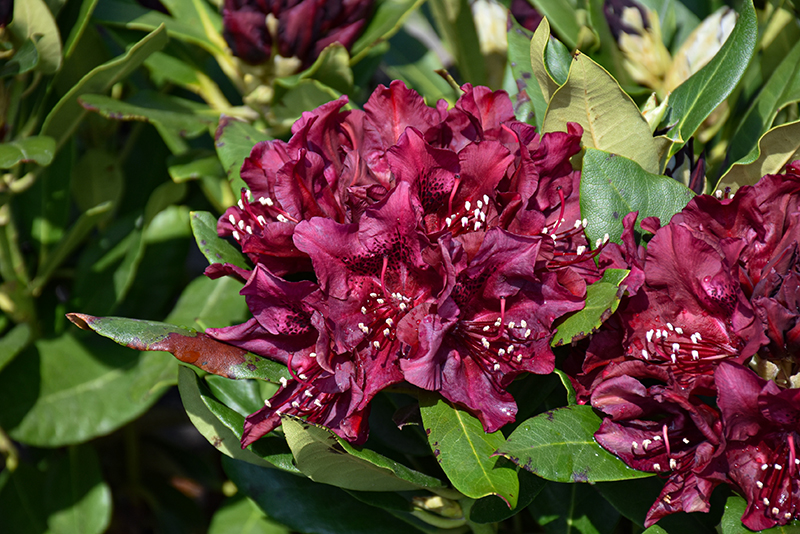
Rhododendron, Dark Lord Rhododendron 'Dark Lord' Height: 8 feet Spread: 7 feet
Sunlight:
Hardiness Zone: 5a Brand: Monrovia Description: An attractive evergreen shrub with deep burgundy flowers in late spring and a broad mounded habit; quite hardy, good in partial shade; absolutely must have well-drained, highly acidic and organic soil; thrives in cooler regions Ornamental Features Rhododendron, Dark Lord is covered in stunning clusters of burgundy trumpet-shaped flowers at the ends of the branches in late spring. It has forest green evergreen foliage. The large narrow leaves remain forest green throughout the winter. Landscape Attributes Rhododendron, Dark Lord is a multi-stemmed evergreen shrub with an upright spreading habit of growth. Its relatively coarse texture can be used to stand it apart from other landscape plants with finer foliage. This is a relatively low maintenance shrub, and should only be pruned after flowering to avoid removing any of the current season's flowers. It has no significant negative characteristics. Rhododendron, Dark Lord is recommended for the following landscape applications; Planting & Growing Rhododendron, Dark Lord will grow to be about 8 feet tall at maturity, with a spread of 7 feet. It tends to be a little leggy, with a typical clearance of 1 foot from the ground, and is suitable for planting under power lines. It grows at a slow rate, and under ideal conditions can be expected to live for 40 years or more. This shrub does best in partial shade to shade. It does best in average to evenly moist conditions, but will not tolerate standing water. This plant should be periodically fertilized throughout the active growing season with a specially-formulated acidic fertilizer. It is very fussy about its soil conditions and must have rich, acidic soils to ensure success, and is subject to chlorosis (yellowing) of the foliage in alkaline soils. It is somewhat tolerant of urban pollution, and will benefit from being planted in a relatively sheltered location. Consider applying a thick mulch around the root zone in winter to protect it in exposed locations or colder microclimates. This particular variety is an interspecific hybrid.